- by MollyJewelryUS
- August 25, 2026
- Buying Guides
🌟 Keys Takeway: How Big Is a Kite-Shaped Stone?
The size of a kite cut engagement ring largely depends on the center stone’s specific measurements in millimeters. According to the reference used in this article:
- 1 ct: approximately 7.80 × 4.60 mm
- 2 ct: approximately 9.83 × 5.80 mm
- 3 ct: approximately 11.25 × 6.63 mm
Defined by sharp angles and a distinctive geometric silhouette, kite cut gemstones bring a modern edge to engagement ring design. But choosing the right size involves more than looking at carat weight alone. You should focus on gem’s length and width, since these factors can create different visual effects.
In this guide to kite cut carat size dimensions, we’ll break down the typical millimeter measurements across carat weights and show you how each size translates visually, so you can find the piece that feels right for you.
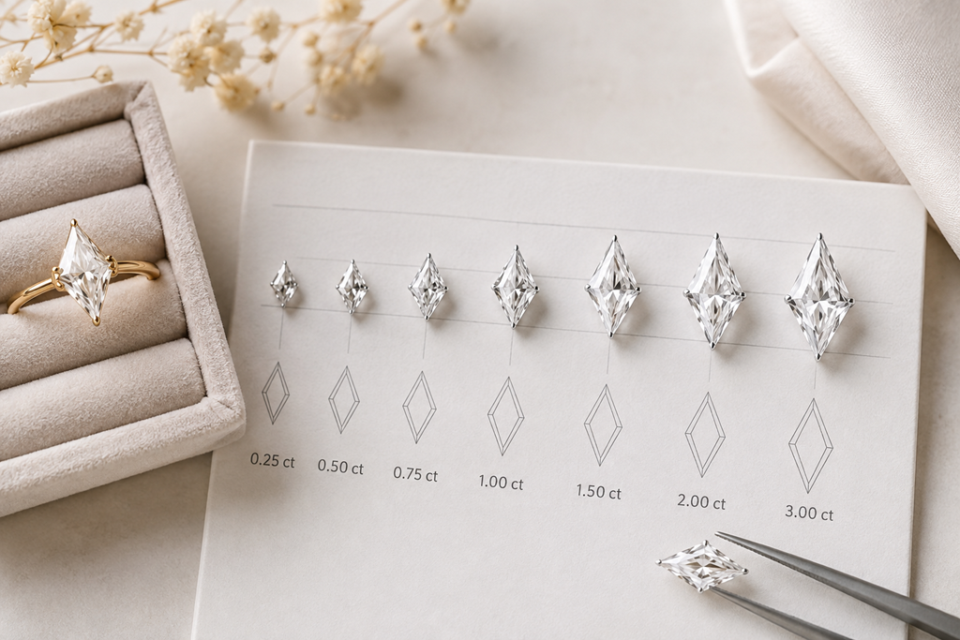
Table of Contents
Why Carat Weight Doesn't Tell You the Exact Kite Cut Size?
Why Carat Weight Doesn't Tell You the Exact Kite Cut Size?
Carat weight and millimeter dimensions are related, but they are not interchangeable. Across all engagement ring cuts:
- Carat weight refers to the gemstone’s weight.
- Millimeter dimensions tell you the stone’s physical size.
This distinction is especially relevant for fancy-shaped stones like the kite cut. Because their proportions, depth, and weight distribution can vary, stones with the equal carat weight may cover different amounts of surface area when viewed face-up.
Explore the Kite Diamond Carat Size Dimensions with Chart
Explore the Kite Diamond Carat Size Dimensions with Chart
For reference, the table below will use a 1.69:1 length-to-width ratio to illustrate the typical millimeter dimensions of kite-shaped diamonds at different carat weights:
| Carat Weight | Approx. Length | Approx. Width |
|---|---|---|
| 0.50 ct | 6.19 mm | 3.65 mm |
| 0.75 ct | 7.09 mm | 4.18 mm |
| 1.00 ct | 7.80 mm | 4.60 mm |
| 1.50 ct | 8.93 mm | 5.27 mm |
| 2.00 ct | 9.83 mm | 5.80 mm |
| 2.50 ct | 10.59 mm | 6.24 mm |
| 3.00 ct | 11.25 mm | 6.63 mm |
| 4.00 ct | 12.38 mm | 7.30 mm |
| 5.00 ct | 13.34 mm | 7.87 mm |
*Important:
- The sizes listed for other carat weights are approximate estimates based on proportions similar to the 1-carat reference diamond. Actual loose stones may vary in their measurements.
- Before buying, always check the specific gem’s length × width × depth to understand its true size.
Are Kite-Cut Gemstone Dimensions Different From Diamonds?
Are Kite-Cut Gemstone Dimensions Different From Diamonds?
Yes, the dimensions listed in a kite cut diamond size chart cannot be directly transferred to other gemstones. Since each gem has their own density, two kite-shaped stones can weigh the same while occupying different amounts of space.
Lower-density materials such as emerald, morganite, and moissanite generally occupy more volume per carat, which can result in larger millimeter dimensions.
However, higher-density gemstones like sapphire, ruby, and garnet are denser than diamond, so the same carat weight may result in a smaller stone.
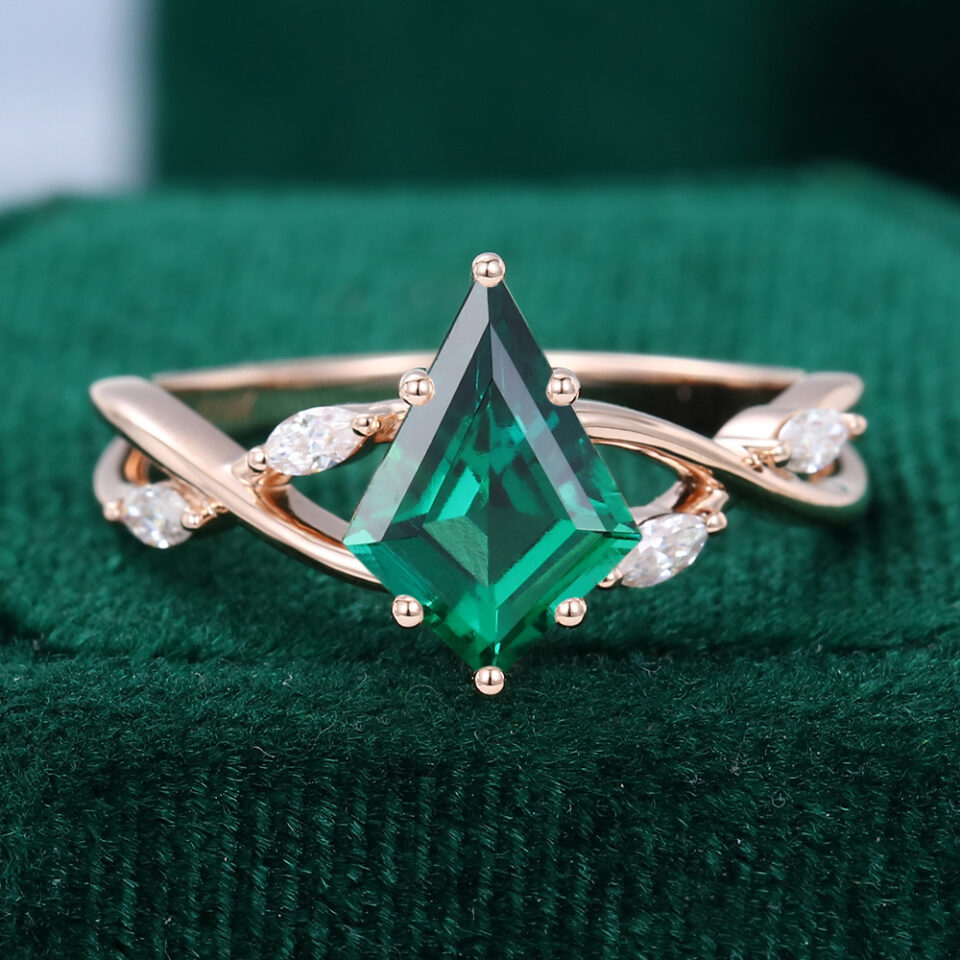
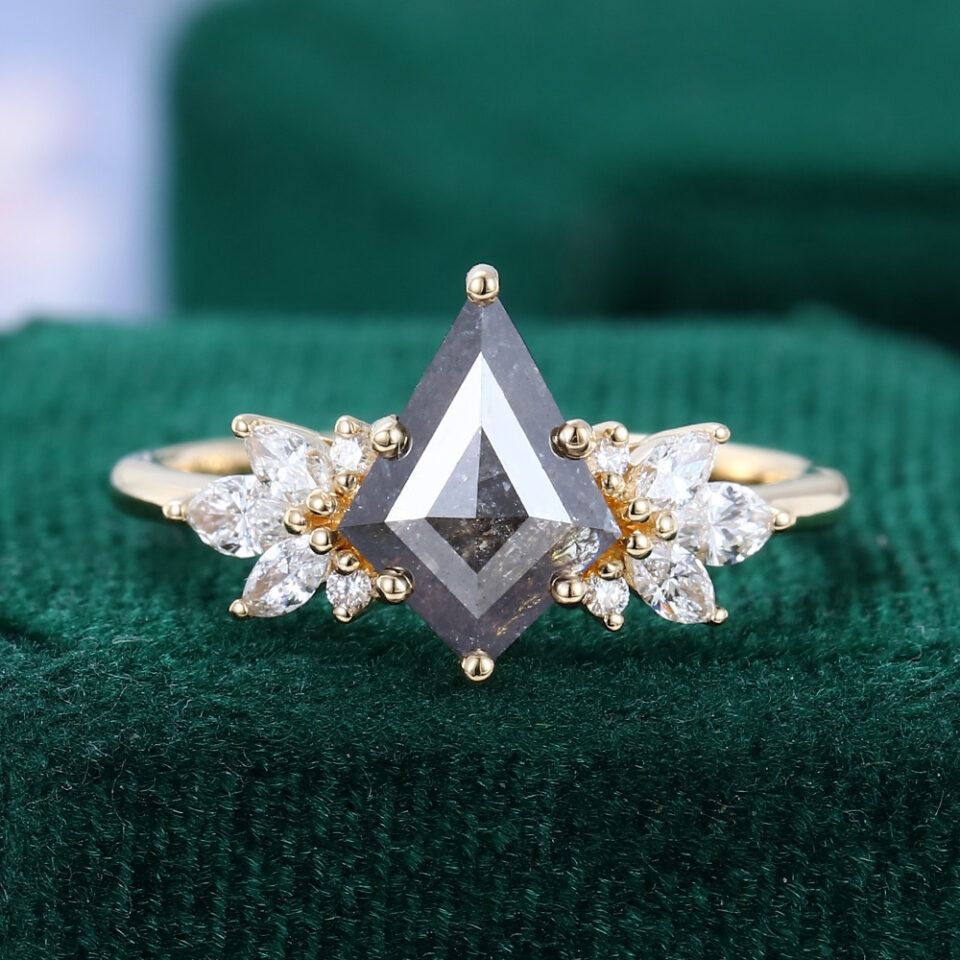
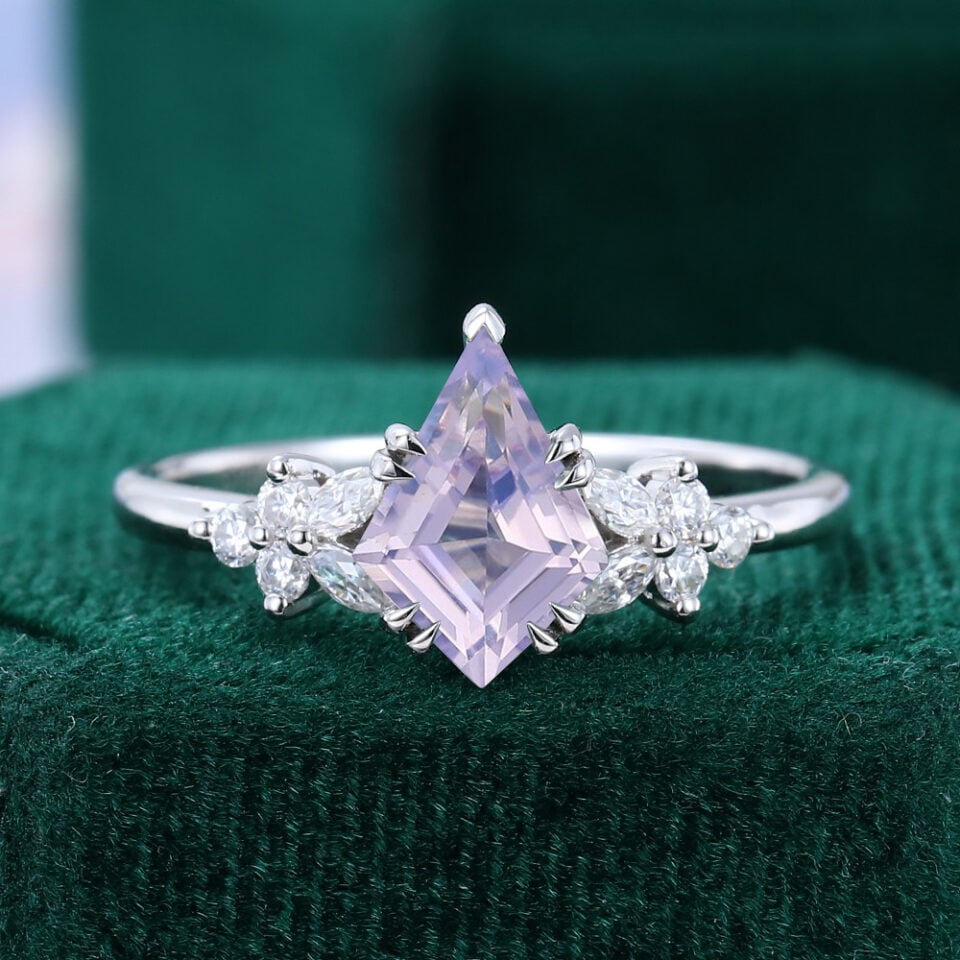
Side-by-Side Comparsion: 1 ct vs 2 ct vs 3 ct Kite Cut
Side-by-Side Comparsion: 1 ct vs 2 ct vs 3 ct Kite Cut
1-carat, 2-carat, and 3-carat kite cut stones are among the most common carat weights considered for timeless engagement ring designs.
If millimeter measurements can’t give you a clear sense of the distinction, let’s take a closer look at how each size actually appears in real life.
How Big Is a 1 Carat Kite Shape Stone?
How Big Is a 1 Carat Kite Shape Stone?
- Visual Appearance: The stone has a refined elongated silhouette, with sharp points and geometric lines that stand out without taking over the entire design.
Take a 1.00 ct kite-cut diamond measuring approximately 7.80 × 4.60 mm as an example. Its defined outline can create a sophisticated solitaire look, while additional side gems can turn the center stone into a more dramatic focal point.
Just remember that its perceived size can still be influenced by the stone’s proportion. A slender kite shape emphasizes length along the finger, while a wider silhouette creates a fuller, more balanced visual presence.
What Does a 2 ct Kite-Shaped Gemstone Look Like?
What Does a 2 ct Kite-Shaped Gemstone Look Like?
- Visual Appearance: The kite shape becomes more prominent and visually striking on the finger.
For comparison, A 2-carat kite-cut stone can reach approximately 9.83 × 5.80 mm, delivering a much stronger presence than a 1-carat piece.The gemstone won’t be twice as long or wide simply because the carat weight has doubled, but the increase in visible surface area is still easy to notice.
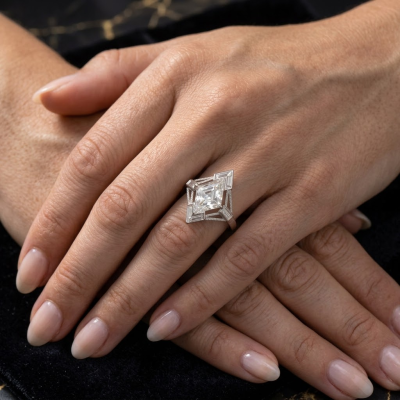
Add a distinctive kite engagement ring setting, and the combination can create a statement look with strong geometric and architectural appeal.
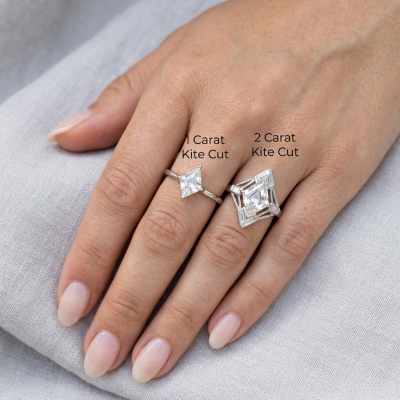
The Visual Effect of a 3 Carat Kite Shape Ring
The Visual Effect of a 3 Carat Kite Shape Ring
- Visual Appearance: Gives the ring a bolder presence, with the kite-shaped center stone taking center stage.
With the same kite cut carat size dimension model, a 3-carat diamond would measure about 11.25 × 6.63 mm. Other gemstones can differ slightly in size because their densities are not the same.
The added length and finger coverage make a 3-carat kite much more statement than a 2-carat stone. It can easily complement a bold, contemporary wardrobe, while its larger profile may call for a more carefully considered wedding band pairing.
👉🏻 Find more inspiration for kite shape engagement ring wedding band pairing here.
How to Choose the Ideal Kite-Shaped Stone Size?
How to Choose the Ideal Kite-Shaped Stone Size?
As we’ve discussed, kite-shaped gemstone size is determined by more than carat weight. The stone’s cut and proportions can affect its final dimensions and visual appearance.
If you’ve compared different sizes and have a specific look in mind, consider the following four factors before making your final choice.
1. Look at Length and Widt
1. Look at Length and Widt
These numbers give you the clearest indication of how much space the stone occupies when viewed from above. For example, a 2 ct kite measuring 10.2 × 5.5 mm may look very different from another 2 ct stone measuring 9.5 × 6.2 mm.
2. Check the Depth Percentage
2. Check the Depth Percentage
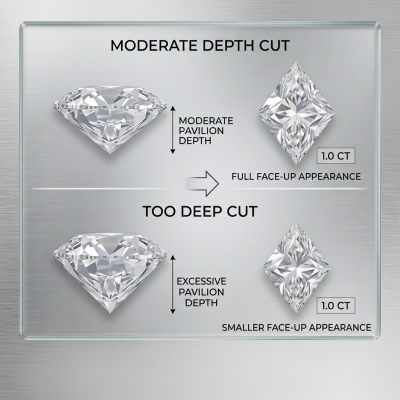
A gemstone’s depth determines how much of its weight is distributed below the face-up surface. When a kite-shaped stone is cut too deeply, more weight can be concentrated in the pavilion rather than contributing to its visible spread.
Comfirming the depth percentage can therefore help you avoid a gem that looks smaller than expected for its carat weight.
3. Compare the Kite's Outline
3. Compare the Kite's Outline
4. Inspect Face-Up Appearance
4. Inspect Face-Up Appearance
Whenever available, review face-up photographs or videos of the actual kite-cut gemstone. This provides a more practical reference for its visible spread and overall size than carat weight alone.
Can Customization Help You Get the Right Kite Stone Size?
Can Customization Help You Get the Right Kite Stone Size?
The answer is yes! A custom engagement ring can give you much more flexibility. Instead of choosing from a limited range of carat weights, you can work toward the specific length, width, and depth you want for your kite-shaped center stone.
At MollyJewelryUS, our custom ring service lets you work with jewelry experts throughout the process, from choosing the gemstone and confirming its dimensions to selecting a setting that complements its shape. This makes it easier to create a kite-cut ring that feels made for you.
Final Thoughts
Final Thoughts
By now, you should have a better understanding of how kite cut carat size dimensions translate into the stone’s appearance. While grading reports provide useful information, the numbers may not determine which kite-cut gemstone will look best on your hand.
Choose based on the silhouette you love, the dimensions that suit your hand, and the style you want your ring to express. When those details come together, your kite engagement ring can become a piece you’ll treasure for years to come.
FAQs for Kite Cut Carat Size Dimensions Chart
FAQs for Kite Cut Carat Size Dimensions Chart
How does pavilion depth alter the visual size of a kite stone?
A deep pavilion concentrates extra carat weight below the girdle. This hidden weight does not contribute to the top-down surface area, causing the stone to appear smaller face-up than its carat weight implies.
Is millimeter size more important than carat for a kite gem?
If your main concern is how large the stone looks from above, millimeter dimensions are generally more informative.
Is there a standard kite cut diamond size chart?
No. Kite cuts do not follow one universal proportion system, so a carat-to-millimeter chart should be treated as an approximate reference rather than a fixed standard.
What are typical kite-shaped gemstone carat sizes?
There is no universal set now. Based on the reference used in this article, a 1 ct kite is about 7.80 × 4.60 mm, while larger carat sizes are estimated through proportional scaling.
Does cut quality affect how large a round stone looks?
Yes. An exceptional cut reflects light edge-to-edge to maximize visual diameter, whereas a poorly cut stone leaks light and creates dark, shrinking borders.
Why do two kite stones with the same carat weight look different in size?
Variations in lapidary cutting style, pavilion depth, girdle thickness, and individual stone outlines cause two gems of the exact equal carat weight to yield different millimeter footprints.