Last updated on March 2, 2026
More and more people are choosing moissanite rings and lab diamond rings as engagement rings. Moissanite and lab diamonds are popular diamond alternatives and are also more ethical and environmentally friendly choices. Therefore, many people are curious about them. In this article, let’s dive into the differences between moissanite and lab diamonds, explore their respective advantages and disadvantages, and help you choose the one that’s best for you!

Table Of Contents:
- Is Moissanite a Lab Diamond?
- What is Moissanite?
- What is a Lab Diamond?
- Moissanite vs. Lab Diamond: What Are the Differences?
- Why Are Lab Diamonds More Expensive Than Moissanite?
- Pros and Cons of Moissanite
- Pros and Cons of Lab Diamonds
- Moissanite vs. Lab Diamond: Which is Better?
- FAQs About Moissanite and Lab Diamonds
Is Moissanite a Lab Diamond?
This is a frequently asked question! Many people think that this diamond-like gemstone is a lab diamond, and some jewelers even refer to moissanite as “moissanite diamonds,” which has caused a lot of confusion. In fact, moissanite is not a lab diamond. They are made of different chemical compositions: moissanite is silicon carbide (SIC), while lab diamonds are carbon (C). Keep reading for a more detailed explanation of the differences between moissanite and lab diamonds.
What is Moissanite?

As mentioned above, moissanite’s chemical composition is silicon carbide, and natural moissanite is even rarer than natural diamonds! Therefore, almost all moissanite jewelry on the market is made from lab-grown moissanite. Just like natural moissanite, lab-grown moissanite shares the same primary chemical composition (SIC) and possesses the same physical and optical properties.
Fun Fact: Although natural moissanite was discovered by Henri Moissan in 1893, Edward Goodrich Acheson successfully synthesized silicon carbide in a lab as early as 1891. (Henri Moissan initially thought he had discovered diamonds, but in 1904, testing revealed it was actually a silicon carbide mineral. Later, the mineral was named “Moissanite” in his honor.)
What is a Lab Diamond?

Simply put, a lab diamond is a diamond that has been produced in a laboratory, and it is also known as a “cultured diamond,” “synthetic diamond,” or “man-made diamond.” All lab-grown gemstones have the same chemical, physical, and optical properties as their natural counterparts. Therefore, the chemical composition of a lab diamond is carbon. The only difference between lab diamonds and natural diamonds is the environment in which they are formed: natural diamonds are created in the Earth’s crust over time, while lab diamonds are made in a laboratory. The only way to distinguish between lab diamonds and natural diamonds is through professional testing.
| Feature | Moissanite | Lab Grown Diamond |
|---|---|---|
| Composition | Silicon carbide (SiC) | Carbon (C) |
| Origin | Lab-grown or natural(very rare) | Lab-grown (CVD/HPHT) |
| Ethical sourcing | Ethical (lab-created) | Ethical |
Moissanite vs. Lab Diamond: What Are the Differences?
While both stones are stunning and look nearly identical at first glance, they possess distinct optical and physical traits. Here is how they compare across four key categories:
1. Color
Both moissanite and lab diamonds are created in a laboratory, which allows them to be produced in all colors. However, the most popular color for both is colorless. In the Colorless (D-E-F) grade, both stones look nearly identical.
Lab diamonds are pure carbon; they lack any “background” tint and stay crisp and white in all lighting conditions. Moissanite occasionally shows a subtle yellow or grayish tint in specific lighting due to its double refraction.
For mainstream 1.0 to 2.0-carat colorless stones, non-professionals can hardly tell them apart by color alone in daily wear.
2. Sparkle (Brilliance & Fire)
Sparkle is the combination of brilliance (white light reflection) and fire (rainbow flashes). While this is primarily determined by a stone’s refractive index and dispersion, the final performance also depends heavily on the gemstone’s quality and the precision of its cut.
| Feature | Moissanite | Lab Grown Diamond |
|---|---|---|
| Refractive index | 2.65–2.69 | 2.42 |
| Dispersion | 0.104 | 0.044 |
| Birefringence | Yes (Double Refraction) | No (Single Refraction) |
| Fire | Vibrant rainbow flashes | Subtle, elegant fire |
| Brilliance | Intense & multifaceted | Crisp & sharp |
| Overall sparkle | Extra fiery, “rainbow” flashes | Classic, crisp diamond brilliance |
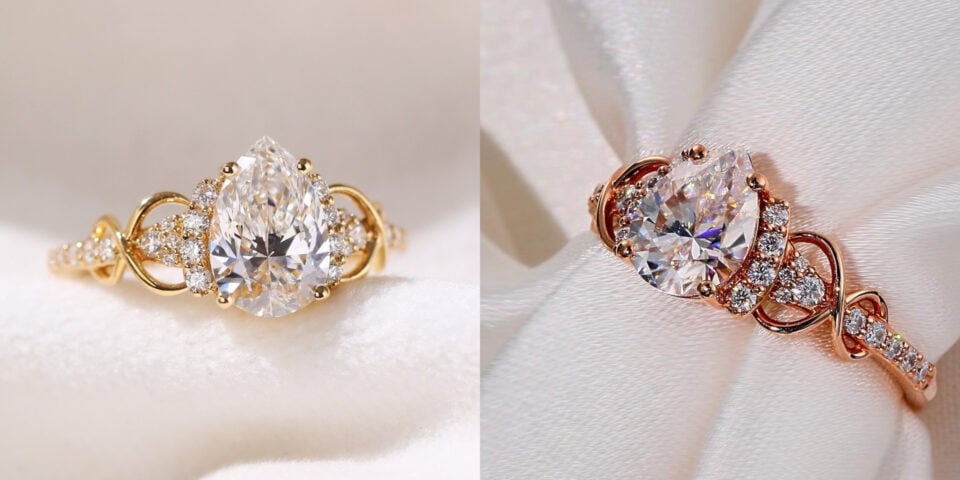
Moissanite with a higher refractive index and dispersion, moissanite is a firework of color. A unique factor is its double refraction: light splits as it enters the stone, creating a dense “kaleidoscope” effect. This makes the stone look incredibly lively and vibrant in almost any lighting.
Lab diamonds are singly refractive, meaning light travels in a cleaner, sharper path. This results in the iconic diamond look—bright white brilliance with a more subtle, elegant fire that often displays cool tones like blue and green.
3. Hardness and Durability
Hardness plays an important role in how well a gemstone holds up over time. On the Mohs scale (which measures scratch resistance from 1 to 10), diamonds rank highest at 10.
Moissanite comes in at 9.25—second only to diamond—making it one of the hardest gemstones available for jewelry. It stands up very well to daily wear. Lab-grown diamonds have the same hardness as natural diamonds, offering maximum scratch resistance and long-term durability.
For practical purposes, both options are strong enough for everyday engagement rings and fine jewelry.
4. Price
Because lab diamonds are harder and a better substitute for natural diamonds, they are more expensive than moissanite. Typically, a 1-carat lab diamond costs several thousand dollars, while moissanite costs only a few hundred dollars. Prices vary by jeweler and are based on the quality of the gemstone and the final jewelry product.
MollyJewelryUS offers affordable, high-quality moissanite and lab diamond jewelry. Our 1-carat moissanite range from $300 to $600, while 1-carat lab diamond range from $1,200 to $3,000.
We know many people often ask, “What kind of gemstone and setting can I get within my budget?“
That’s why we’ve curated three classic combinations to help you explore your options.
| Budget | Recommended Combination | Best For |
|---|---|---|
| ~$1,000 | 1.0ct Moissanite + Minimalist 14K Gold Setting | First-time buyers, or those who love value and visual impact |
| ~$2,000 | 0.5ct Lab Diamond + Moissanite Accents + 18K Setting | Couples seeking quality and sustainable choices |
| ~$3,000 | 1.0ct Lab Diamond (or larger Moissanite) + Premium Setting (Platinum / 18K) | For those who appreciate design, craft, and longevity |
Curious to see what your budget can bring to life?
Share your style and budget, and our jewelry consultants will create a personalized plan just for you.
💬 Start Your Free Custom Consultation →
Why Are Lab Diamonds More Expensive Than Moissanite?
This is an interesting question. Since both lab diamonds and moissanite are created in a laboratory, why is the price of lab diamonds so much higher than moissanite? Let’s dive deeper into the reasons.
- Production Costs: Lab diamonds are grown by simulating the high-pressure, high-temperature conditions in which natural diamonds form. This process requires precise instruments and a significant amount of energy and effort. In contrast, moissanite’s production process is relatively simple and less expensive, making lab diamond production more costly than moissanite production.
- Market Positioning: Lab diamonds are marketed as identical to natural diamonds and the best diamond substitute. Through branding and marketing, lab diamonds are positioned as a high-end product line, which justifies their higher prices. Moissanite, on the other hand, has always been positioned as an affordable alternative to diamonds, making it more budget-friendly.
- Supply: The technology to produce moissanite is more mature, resulting in higher production volumes. Lab diamond technology is newer, so production is still relatively low. As the saying goes, “scarcity increases value,” and this is one reason lab diamonds are more expensive than moissanite.
Pros and Cons of Moissanite
If you are considering purchasing a moissanite engagement ring or jewelry, weigh the following pros and cons.
Pros:
- Affordable Price: Compared to lab diamonds and natural diamonds, moissanite is more budget-friendly.
- Excellent Fire: Moissanite has a high refractive index and dispersion value, giving it strong fire, and even more brilliance than diamonds.
- High Hardness: Moissanite is second only to diamonds in hardness, making it highly resistant to wear.
- High Clarity: Since moissanite is lab-created, it often has very high clarity, reaching colorless and flawless levels.
- Environmentally Friendly and Ethical: As a lab-grown gemstone, moissanite does not involve environmental damage or unethical labor practices associated with mining.
Cons:
- Optical Characteristics vs. Natural Diamonds: Moissanite’s optical appearance is different from natural diamonds. Its dispersion and refractive behavior create a distinctive sparkle that some people may find less similar to traditional diamonds.
- Not Natural: Moissanite is a synthetic gemstone, which may not appeal to those who prefer natural gemstones.
- Clarity Issues: Due to its double refraction, the light reflected by moissanite can appear slightly blurred, lacking sharp clarity. However, this is a natural optical characteristic of the material and not a quality defect.
Pros and Cons of Lab Diamonds
If you are considering purchasing lab diamond rings or jewelry, weigh the following pros and cons.
Pros:
- Identical to Natural Diamonds: Lab diamonds have the same chemical composition and crystal structure as natural diamonds, making them virtually indistinguishable in appearance.
- Environmentally Friendly and Ethical: The production of lab diamonds is relatively eco-friendly, causing no environmental damage or conflicts associated with mining.
- Controlled Quality: Lab diamonds undergo strict quality control, ensuring that each one meets high standards.
- High Durability: Like natural diamonds, lab diamonds are the hardest gemstones, making them extremely durable.
Cons:
- Higher Price: Lab diamonds are more expensive compared to moissanite.
- Brand Impact: Lab diamonds lack the brand recognition of natural diamonds, and consumer awareness is relatively lower.
- Emotional Value: Since lab diamonds are man-made, they may lack the emotional significance that people associate with natural diamonds, which are seen as having greater meaning due to their long natural formation process.
Moissanite vs. Lab Diamond: Which is Better?
The best one is what suits you. There’s no definitive answer to this question because each person has different needs, so the answer varies for different individuals. Ultimately, it depends on your preferences.
Who is Moissanite suitable for?
People who meet any of the following conditions:
- Are on a budget and looking for cost-effectiveness.
- Want a stone that sparkles more than a diamond.
- Seek high durability.
- Are environmentally conscious and prioritize ethical, sustainable choices.


Who is Lab Diamond suitable for?
People who meet any of the following conditions:
- Want a gem that looks identical to a natural diamond.
- Desire the hardest and most durable gemstone.
- Are environmentally conscious and prioritize ethical, sustainable choices.
- Want a gem that retains higher resale value.

Related: White Sapphire vs. Diamond: Full Comparison
FAQs About Moissanite and Lab Diamonds
If you’re seeking a high value-for-money option and care about environmental and ethical issues, moissanite is definitely worth buying.
Yes, lab diamonds are real diamonds; the only difference is that they are created in a lab rather than formed naturally.
Moissanite is a genuine gemstone, but some sellers use it to mimic diamonds, which is why it’s sometimes referred to as a “fake diamond.”
The simplest way is by observing the gem’s brilliance and fire. Moissanite has intense sparkle and displays a rainbow of colors. Lab diamonds have a softer sparkle, with fire tending to cooler tones like blue and green.
Yes, many handheld diamond testers measure thermal conductivity. Since moissanite also has high thermal conductivity, it can pass a diamond tester.
Moissanite is more sparkly than lab-grown diamonds. This is due to its higher refractive index, which means it bends light more strongly than diamonds do. This results in a more intense and colorful display of fire.
In normal lighting and daily wear, most people cannot tell the difference with the naked eye. The variation in sparkle is subtle and usually noticeable only under close inspection or professional testing.