- by MollyJewelryUS
- July 6, 2026
- Gemstone Education
Choosing an amethyst ring today is no longer just about color or design. One of the biggest questions buyers face is whether to choose a lab-created amethyst or a natural amethyst.
At first, the answer seems simple—many people assume natural must be better. But when it comes to jewelry, that’s not necessarily true.
Both gemstones offer the same everyday durability, similar brilliance, and nearly identical appearance. In fact, most people can’t tell them apart once they’re set in a ring. The real differences lie in origin, rarity, price, and the value you place on each.
Instead of comparing scientific facts you’ll probably never use, this guide focuses on the questions that actually matter when buying a ring—helping you decide which type of amethyst best fits your style, budget, and expectations.
If you’re still deciding whether an amethyst ring is the right choice overall, our Amethyst Ring Buying Guide explains everything you should know before making your purchase.
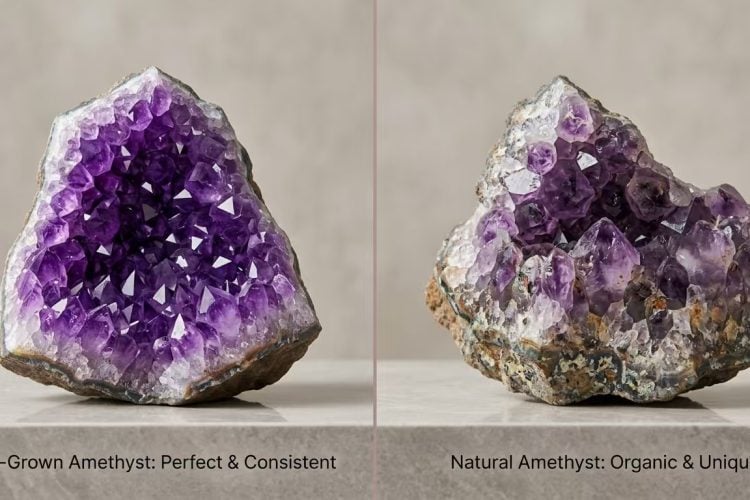
Table of Contents
Quick Answer: Lab-Created vs Natural Amethyst
Quick Answer: Lab-Created vs Natural Amethyst
If your goal is to buy a beautiful ring you’ll enjoy wearing every day, both lab-created and natural amethyst are excellent choices.
They share the same mineral composition, the same Mohs hardness of 7, and very similar optical properties. For most buyers, the biggest differences aren’t durability or appearance—they’re origin, rarity, availability, and price.
Quick Comparison:
| Feature | Lab-Created Amethyst | Natural Amethyst |
|---|---|---|
| Appearance | Nearly identical | Nearly identical |
| Hardness | 7 | 7 |
| Everyday Wear | Excellent | Excellent |
| Color Consistency | Excellent | Naturally varies |
| Origin | Laboratory grown | Formed in nature |
| Price | More affordable | Usually higher |
Quick Tip: If you didn’t know which was which, there’s a good chance you wouldn’t notice the difference just by looking at the ring.
The Differences That Matter—and the Ones That Don't
The Differences That Matter—and the Ones That Don't
It’s easy to compare every specification on a gemstone, but not every difference deserves the same attention.
Some factors genuinely affect how your ring looks, feels, and fits your budget. Others sound important on paper but make very little difference once the ring is on your finger.
Here’s how to separate the differences that truly matter from those that usually don’t.
✔ Matters: Overall Beauty
✔ Matters: Overall Beauty
When you look at an amethyst ring, you notice its color, sparkle, and design—not where the gemstone formed.
A beautifully cut lab-created amethyst can be just as eye-catching as a natural one.
Bottom line: Always prioritize the ring’s overall appearance.
✔ Matters: Your Budget
✔ Matters: Your Budget
If you’re working within a specific budget, choosing a lab-created amethyst can open up more design possibilities.
Instead of paying extra for natural origin, many buyers prefer investing in better craftsmanship, a premium metal, or a larger center stone.
Bottom line: Spend where you’ll see the biggest difference every day.
If budget is one of your biggest considerations, it’s also worth reading How Much Does an Amethyst Ring Cost?, where we break down real market prices and what influences the final cost of an amethyst ring.
✔ Matters: Your Personal Preference
✔ Matters: Your Personal Preference
Some buyers simply enjoy the uniqueness of a naturally formed gemstone, while others care more about design, customization, or value.
Neither choice is right or wrong.
Bottom line: Buy the ring that fits your priorities—not someone else’s.
✘ Doesn't Matter Much: Everyday Durability
✘ Doesn't Matter Much: Everyday Durability
Both natural and lab-created amethyst share the same hardness and are equally suitable for daily wear with proper care.
A protective setting and good wearing habits will have a much greater impact on longevity.
Bottom line: Origin doesn’t make one tougher than the other.
Since both types share the same hardness, you can also explore How Durable Is Amethyst? for a closer look at everyday wear and long-term durability.
✘ Doesn't Matter Much: Visual Differences
✘ Doesn't Matter Much: Visual Differences
Without professional gemological equipment, most people won’t be able to identify whether an amethyst is natural or lab-created simply by looking at it.
What catches people’s attention is beautiful color and thoughtful design.
Bottom line: Focus on what you can actually see and enjoy.
Quick Takeaway:
The biggest mistake buyers make is assuming every difference carries equal weight.
In reality, appearance, craftsmanship, budget, and personal preference are what shape your experience with a ring. Whether the amethyst formed underground or in a laboratory is often a secondary consideration for everyday jewelry.
Common Myths About Lab-Created Amethyst
Common Myths About Lab-Created Amethyst
Lab-created amethyst has become increasingly common in fine jewelry, yet many misconceptions still influence buying decisions. Let’s separate the myths from the facts.
Myth #1: "Lab-Created Amethyst Isn't Real"
Myth #1: "Lab-Created Amethyst Isn't Real"
Reality: It’s real amethyst.
This is probably the biggest misunderstanding.
Lab-created amethyst isn’t glass, cubic zirconia, or dyed quartz. It’s genuine quartz crystal with the same chemical composition, crystal structure, and physical properties as natural amethyst. The only meaningful difference is how the crystal was formed.
Natural amethyst grows underground over millions of years, while lab-created amethyst is grown under carefully controlled laboratory conditions that replicate the natural crystal-growing process.
Quick Tip: “Lab-created” doesn’t mean “fake.” It simply describes the gemstone’s origin.
Myth #2: "Natural Amethyst Always Looks Better"
Myth #2: "Natural Amethyst Always Looks Better"
Reality: Beauty depends on quality—not origin.
Many buyers assume natural gemstones automatically have richer color or greater brilliance. In reality, both natural and lab-created amethyst can display beautiful purple hues when they’re well cut.
The features that most influence appearance include:
- Color saturation
- Cut precision
- Clarity
- Ring craftsmanship
These characteristics have a much greater impact on how a ring looks than whether the gemstone formed in nature or a laboratory.
If you’re wondering what actually makes an amethyst look its best, our guide to the Best Cut for an Amethyst Ring explains which shapes maximize color and brilliance.
Myth #3: "Lab-Created Amethyst Doesn't Last as Long"
Myth #3: "Lab-Created Amethyst Doesn't Last as Long"
Reality: Both offer the same everyday durability.
Since natural and lab-created amethyst share a Mohs hardness of 7, they resist everyday wear in the same way.
How long your ring lasts depends far more on:
- The ring setting
- Daily wearing habits
- Regular cleaning and maintenance
With proper care, either type of amethyst can remain beautiful for many years.
Proper maintenance matters far more than origin. Our complete Amethyst Ring Care Guide covers cleaning, storage, and everyday care tips.
Myth #4: "Natural Amethyst Is Always Worth Paying More For"
Myth #4: "Natural Amethyst Is Always Worth Paying More For"
Reality: It depends on what you value most.
Natural amethyst may appeal to buyers who appreciate a gemstone formed by nature, while lab-created amethyst often appeals to those looking for exceptional beauty and value.
Neither option is universally “better.”
Instead, ask yourself:
- Do you value natural origin?
- Is staying within budget more important?
- Would you rather invest in a larger stone or a more detailed setting?
For many jewelry buyers, these questions are more meaningful than the gemstone’s origin alone.
Can You Actually Tell the Difference?
Can You Actually Tell the Difference?
In most cases, no.
Once an amethyst has been cut, polished, and set into a ring, distinguishing a natural gemstone from a lab-created one is extremely difficult through appearance alone.
Most buyers simply notice:
- The richness of the purple color
- How much the gemstone sparkles
- The overall ring design
- The quality of the craftsmanship
Professional gemologists may use advanced testing equipment to determine a gemstone’s origin, but for everyday jewelry, the visual differences are usually minimal.
Bottom Line: If two rings are equally well made, most people won’t know—or care—whether the amethyst is natural or lab-created.
If you’re trying to identify a gemstone, you may also find our guide on How to Choose an Amethyst Ring helpful when evaluating overall quality.
Why Are More Jewelry Brands Choosing Lab-Created Amethyst?
Why Are More Jewelry Brands Choosing Lab-Created Amethyst?
Over the past few years, lab-created gemstones have become increasingly popular in engagement rings, promise rings, and fine jewelry—not because they’re replacing natural gemstones, but because they offer a practical balance of beauty, consistency, and value.
For jewelry brands, lab-created amethyst provides several advantages:
- Consistent color across different designs
- Greater flexibility for custom rings and matching sets
- Reliable availability throughout the year
- Better value for buyers without compromising everyday durability
For customers, this often means having more choices in ring styles, gemstone sizes, and precious metal options while staying within the same budget.
That’s one reason many modern collections—including handcrafted engagement and promise rings—feature lab-created amethyst as a beautiful and practical choice for everyday jewelry.
Key Takeaway:
The conversation around lab-created amethyst vs natural amethyst often focuses on where the gemstone comes from. But for most people, the more important questions are simpler:
- Does the ring look beautiful?
- Will it last?
- Does it fit my budget?
- Does it feel meaningful to me?
Once those questions are answered, the gemstone’s origin becomes just one part of the overall decision—not the deciding factor.
Which Amethyst Is the Right Choice for You?
Which Amethyst Is the Right Choice for You?
After comparing the facts, you may realize there isn’t a single “better” option. Instead, the right choice depends on what matters most to you.
Here’s a simple way to decide.
Choose Lab-Created Amethyst If...
Choose Lab-Created Amethyst If...
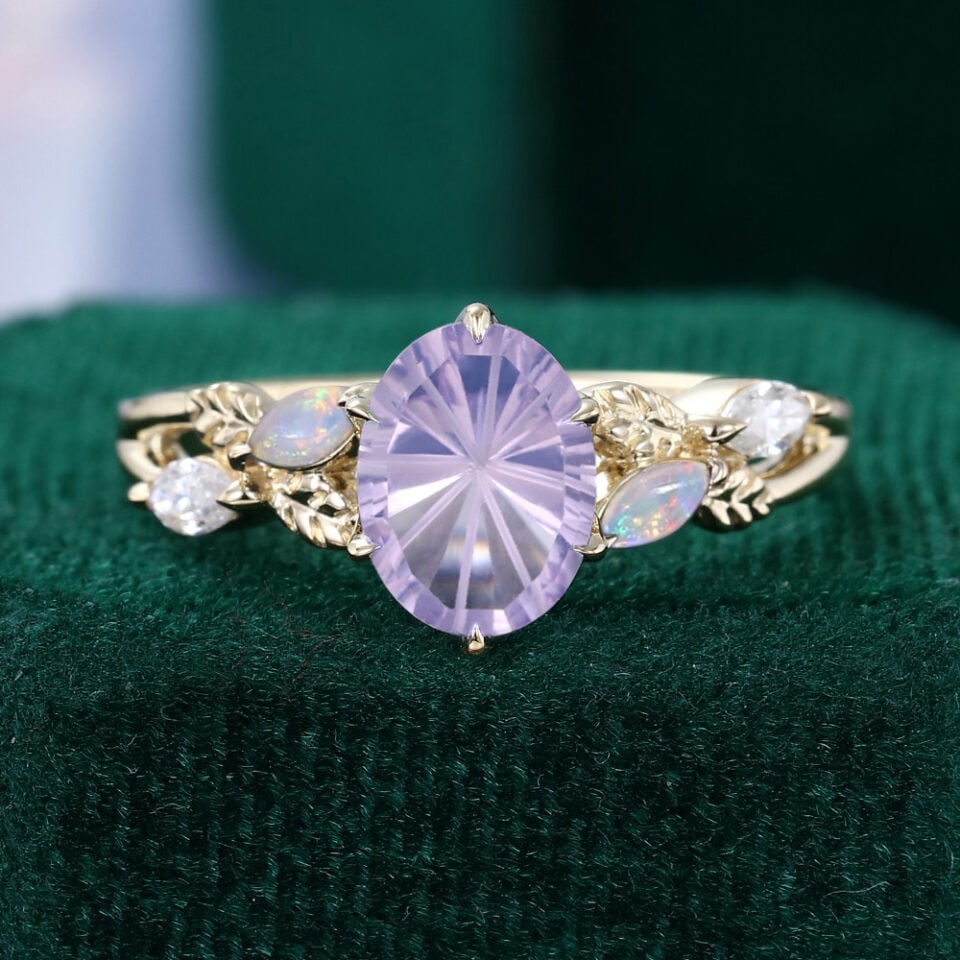
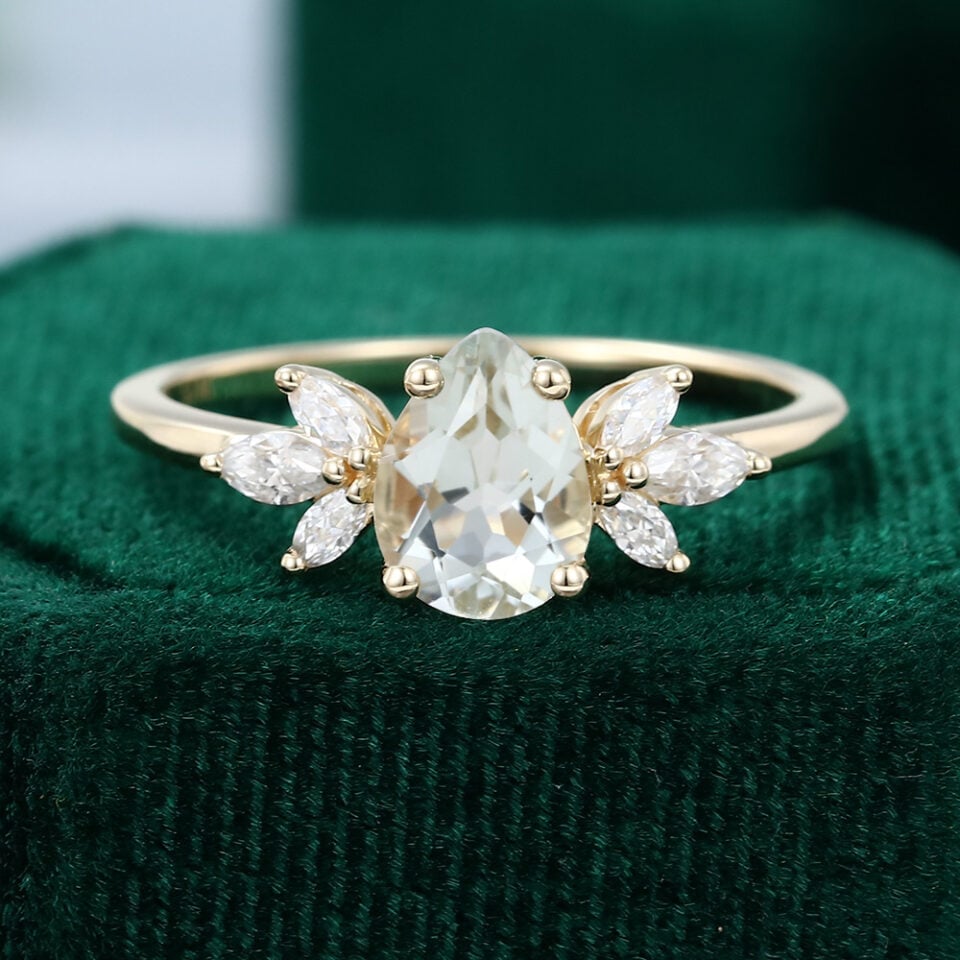
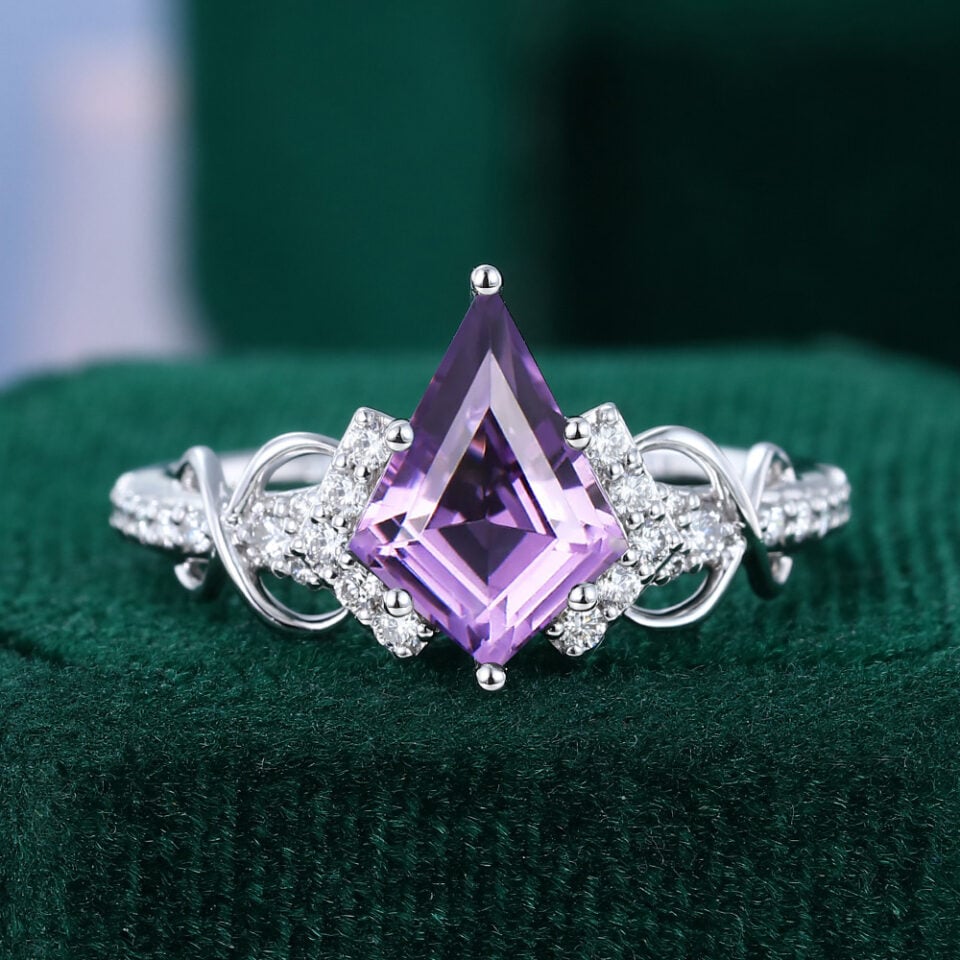
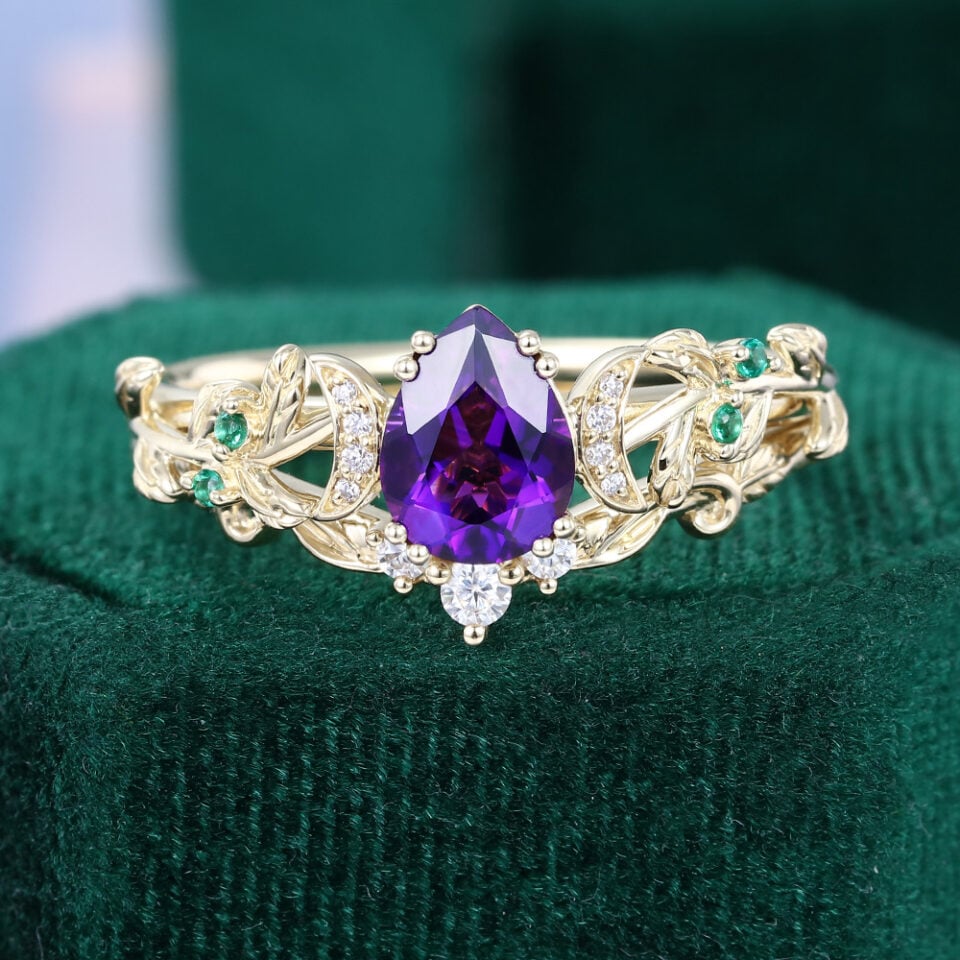
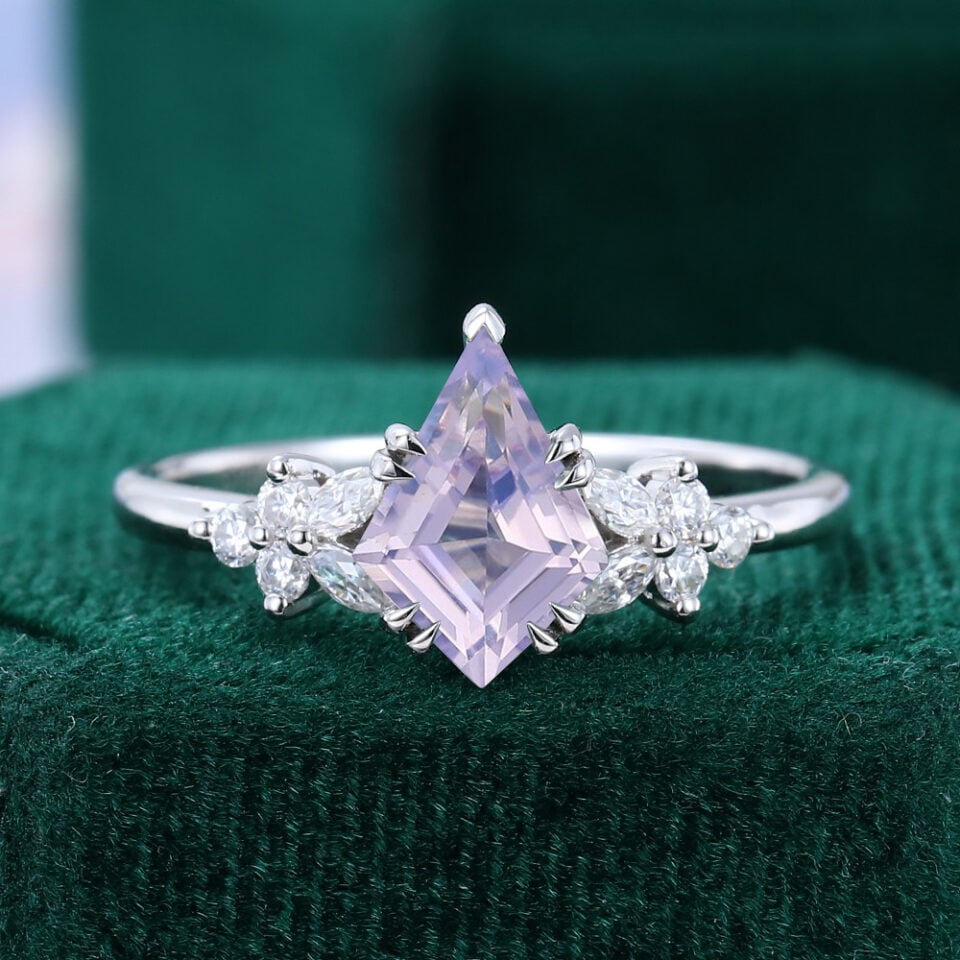
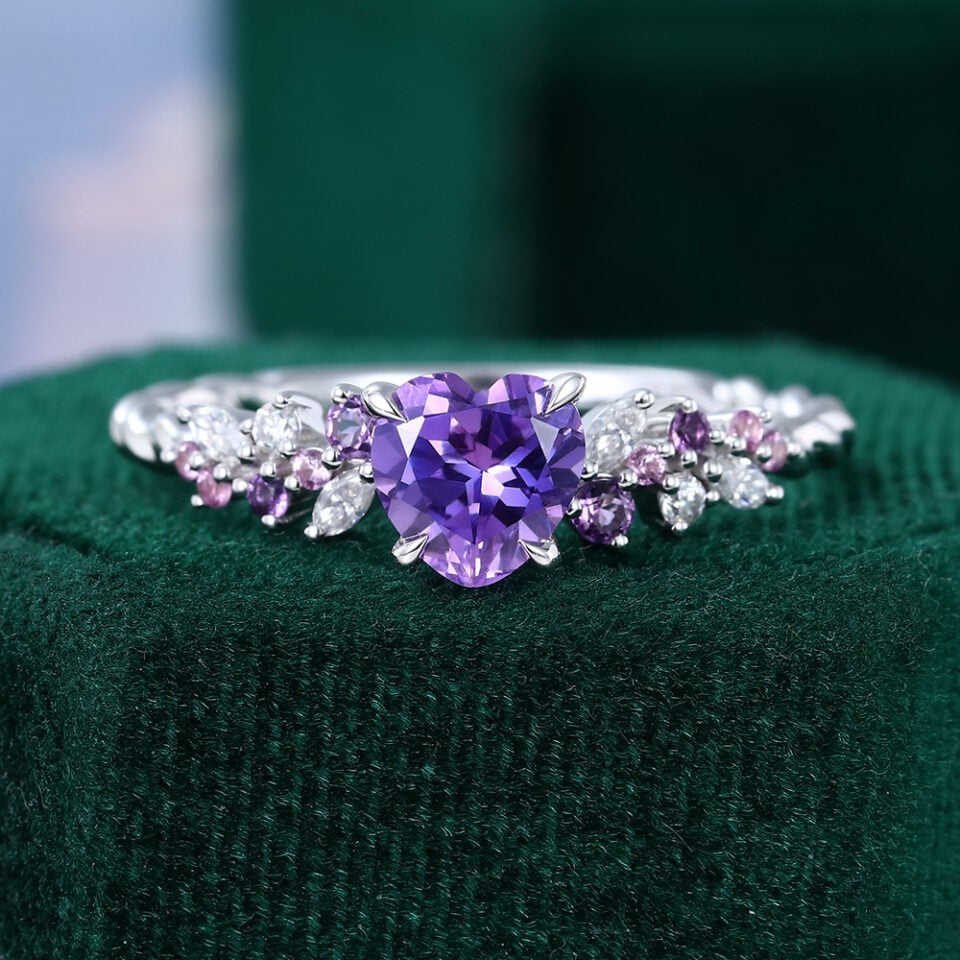
Lab-created amethyst is an excellent choice for buyers who want the best combination of beauty, quality, and value.
It may be the better option if you:
- Want a beautiful ring while staying within your budget
- Prefer consistent color and clarity
- Love larger center stones or more detailed designs
- Plan to wear the ring every day
- Want to maximize your budget on craftsmanship or precious metals
For many couples, these advantages make lab-created amethyst a practical and attractive choice for engagement rings, promise rings, and meaningful gifts.
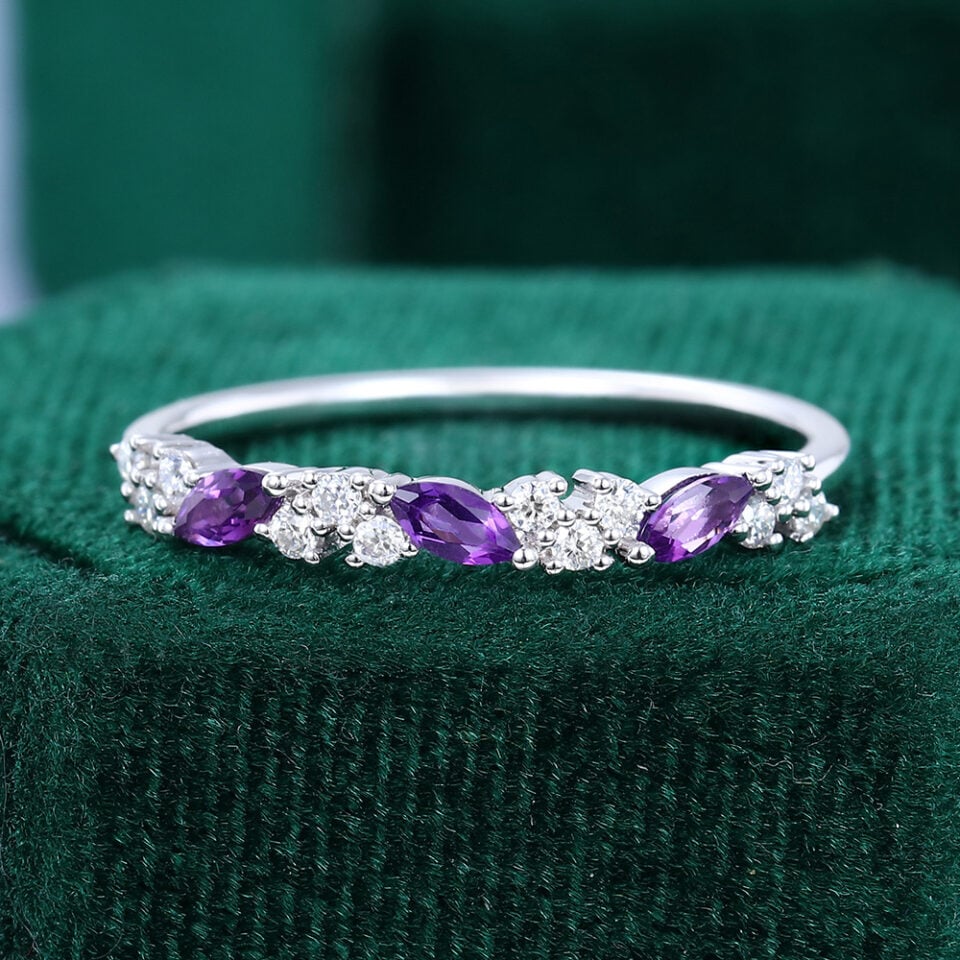
Best for: Everyday jewelry, custom designs, modern engagement rings, and buyers who value overall design.
Once you’ve decided on the gemstone type, choosing the right design is the next step. Explore our guide to the Best Amethyst Ring Styles for inspiration.

Choose Natural Amethyst If...
Choose Natural Amethyst If...
Natural amethyst may be worth considering if the gemstone’s origin is an important part of its meaning to you.
You might prefer natural amethyst if you:
- Enjoy owning gemstones created by nature
- Appreciate the uniqueness of naturally formed crystals
- Prefer jewelry with a geological story
- Don’t mind paying more for natural origin
For these buyers, the emotional connection to a naturally formed gemstone can be just as valuable as its appearance.
Best for: Nature enthusiasts, gemstone collectors, and buyers who prioritize natural origin.
Final Thoughts
Final Thoughts
The debate between lab-created amethyst and natural amethyst isn’t about deciding which gemstone is universally better—it’s about understanding which one is better for you.
Natural amethyst offers the appeal of a gemstone shaped by nature over millions of years, while lab-created amethyst delivers the same everyday beauty and durability with greater consistency and value. Neither choice is objectively superior, and both can become meaningful pieces of fine jewelry.
Rather than focusing on the gemstone’s origin alone, consider the qualities you’ll appreciate every time you wear your ring: a beautiful purple color, thoughtful craftsmanship, a secure setting, and a design that reflects your personal style.
In the end, the best amethyst ring isn’t defined by where the gemstone came from—it’s the one you’ll enjoy wearing for years to come.
FAQs
FAQs
Is lab-created amethyst considered real?
Yes. Lab-created amethyst is real quartz with the same chemical composition, crystal structure, and hardness as natural amethyst. The difference is simply that it is grown in a laboratory rather than formed underground.
Is lab-created amethyst fake?
No. A lab-created amethyst is not imitation glass or plastic. It’s a genuine amethyst created under controlled conditions.
Can you tell the difference between natural and lab-created amethyst?
Usually not.
Once set into a ring, most people cannot distinguish them by appearance alone. Professional gemological testing is often required to determine the gemstone’s origin.
Is natural amethyst more durable?
Both natural and lab-created amethyst have a Mohs hardness of 7, making them equally suitable for everyday jewelry when properly cared for.
Why is natural amethyst usually more expensive?
The higher price generally reflects its natural origin and limited supply rather than a significant difference in appearance or durability.
Which is better for an engagement ring?
Both are suitable choices.
If your priority is value, consistent color, and design flexibility, lab-created amethyst is often the more practical option. If natural origin holds personal meaning, natural amethyst may be the better fit.