
- by MollyJewelryUS
- January 29, 2026
- Buying Guides
As moss agate continues to surge in popularity, the market has become flooded with options ranging from breathtaking natural scenes to dull, poorly cut stones that are too fragile for everyday wear.
To identify high-quality moss agate for a ring, consider three key factors: visual balance, light transmission, and structural integrity.
In this guide, MollyJewelryUS explains how to recognize a ring-worthy stone, when a higher price is justified, and how to shop for moss agate rings with confidence.
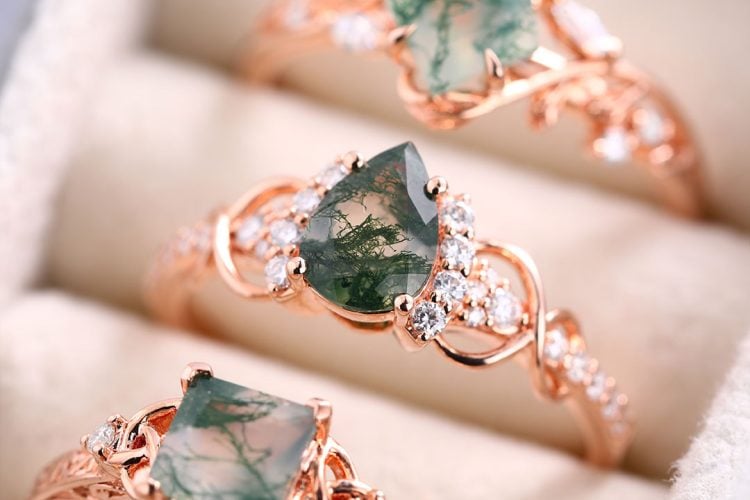
Table Of Contents:
Table Of Contents:
- Quality vs. Authenticity: Why “Real” Isn’t Enough
- 1. Moss Distribution & Pattern
- 2. The Transparency Spectrum
- 3. Color Tone & Contrast
- 4. The “Cut” Matters
- 5. Structural Quality: Thickness, Integrity & Wearability
- 6. Light Performance on the Hand
- 7. Price Signals: When Higher Quality Is Worth It
- How to Buy a High-Quality Moss Agate Ring
- Conclusion
- FAQ: High-Quality Moss Agate
Quality vs. Authenticity: Why "Real" Isn't Enough
Quality vs. Authenticity: Why "Real" Isn't Enough
Most of the moss agate sold today is genuine. The real question is not whether a stone is moss agate but rather how well it will perform once set in a ring.
High-quality moss agate stands out in three ways:
- It remains visually clear and engaging at small sizes.
- It is cut to showcase, not flatten, the natural pattern.
- It has the thickness and integrity to survive daily wear.
This guide focuses on quality benchmarks, not basic authenticity checks. If you need help verifying whether a stone is real, see our separate guide: How to Tell if a Moss Agate Ring Is Real.
1. Moss Distribution & Pattern
1. Moss Distribution & Pattern
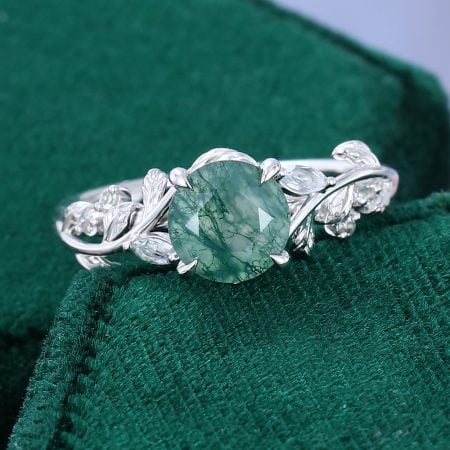
Intentional, readable patterns at the ring scale define the high-quality moss agate. The inclusions should appear organized, not chaotic.
Look for:
- Clear focal points with visible negative space
- Branches or dendrites that remain distinct at 6-8 mm
Avoid stones where the inclusions collapse into a dark mass once mounted. At arm’s length, these often appear muddy or flat rather than scenic.
2. The Transparency Spectrum
2. The Transparency Spectrum
Transparency determines depth. It is one of the strongest price drivers in moss agate.
- Premium clarity: A clear quartz base that allows light to pass through, creating layered depth. The moss appears to float rather than sit on a flat plane.
- Commercial clarity: A milky or cloudy chalcedony base. While some people enjoy its soft appearance, excessive cloudiness obscures detail and reduces depth.
Practical check: View the stone in natural daylight at arm’s length. A ring-quality moss agate should display layers in the foreground and background, not a single opaque surface.
If a stone only looks impressive when backlit, it is not ideal for a ring.
3. Color Tone & Contrast
3. Color Tone & Contrast
Contrast determines clarity. The relationship between color and contrast distinguishes high quality.
High-quality moss agate typically features:
- A pale or colorless base that enhances visibility
- Forest green or muted olive inclusions that stand out clearly
Lower-quality stones often appear gray, yellowed, or low-contrast. This causes branch structures to blend into the background once the stone is reduced to ring size.
Remember, small stones reduce contrast. A dramatic slab may lose definition when cut down, so always evaluate how the pattern holds up at the intended finished size.
4. The "Cut" Matters
4. The "Cut" Matters
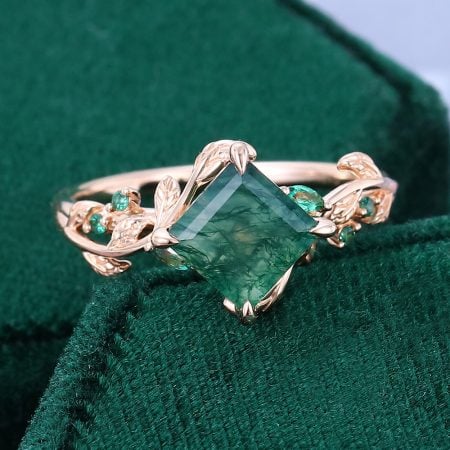
In traditional gemstones like diamonds, the cut is about sparkle. In moss agate, the cut is about composition.
A good cut:
- Centers the most compelling part of the pattern
- Shapes the dome or table to encourage light penetration
- Maintains even thickness to avoid stress points
A poor cut can flatten the scene, highlight a weak area, or leave thin edges that compromise durability. Many mediocre stones become disappointing rings due to careless cutting.
5. Structural Quality: Thickness, Integrity & Wearability
5. Structural Quality: Thickness, Integrity & Wearability
A moss agate ring must survive real life.
What jewelers look for:
- Adequate thickness: A substantial “belly” that resists cracking during setting and wear
- Surface integrity: A smooth, mirror polish with no surface-reaching fractures
- Internal soundness: No visible shatter lines or hollow pockets (vugs).
Stones with internal voids or black pits are typically rejected because they weaken the structure and appear as holes rather than moss.
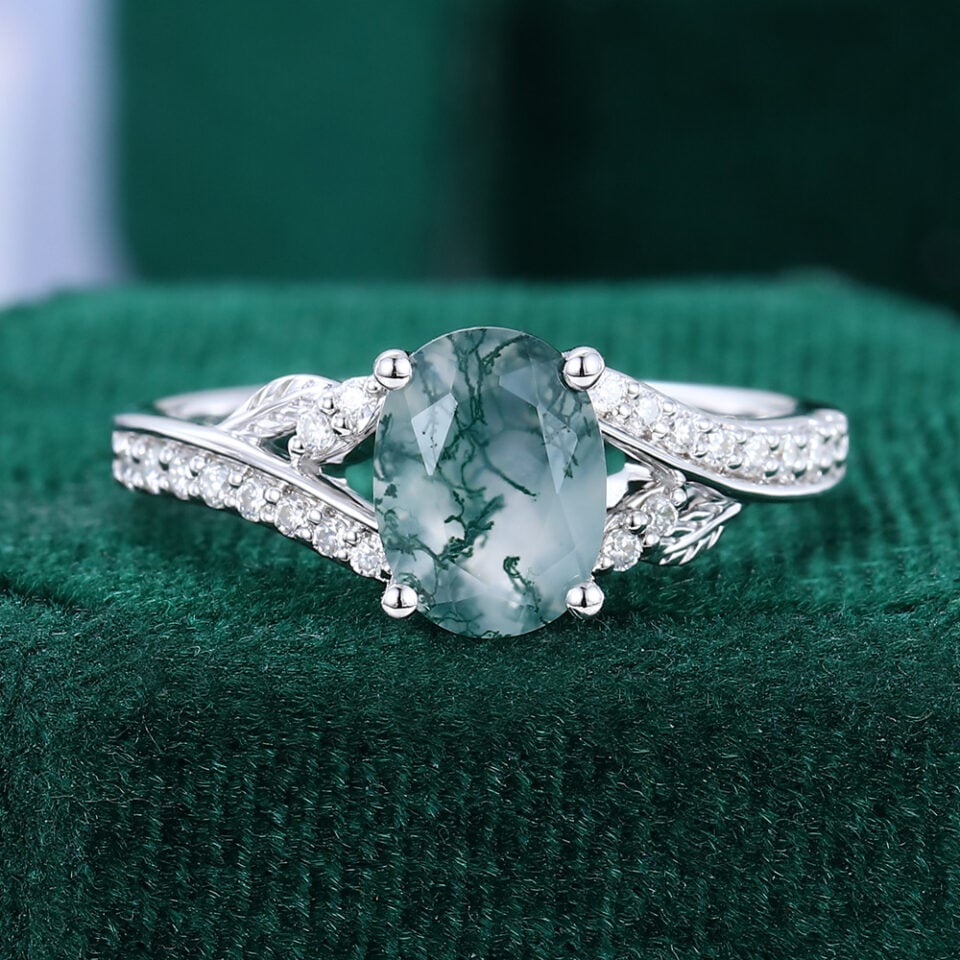
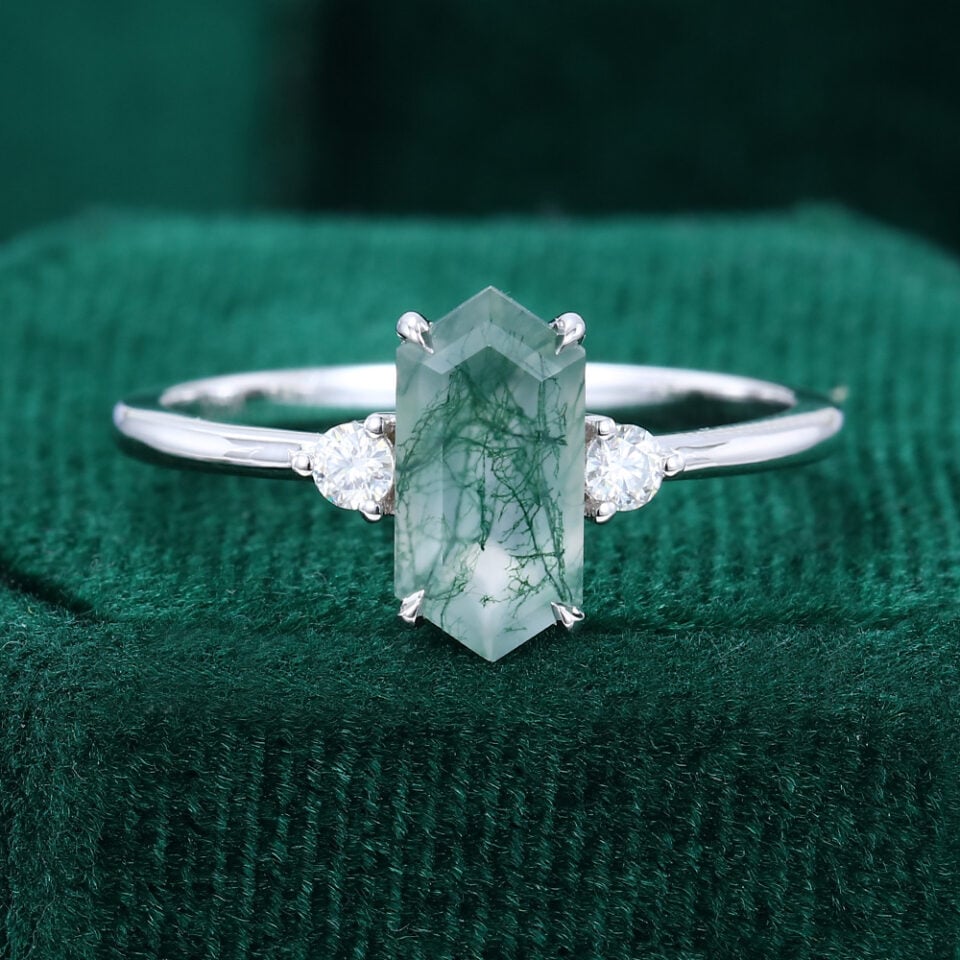
At MollyJewelryUS, we only select moss agate that falls within the 6.5–7 Mohs hardness range and passes wearability screening for ring use. This level of screening is especially important for moss agate engagement rings, where daily wear demands both beauty and long-term durability.

6. Light Performance on the Hand
6. Light Performance on the Hand
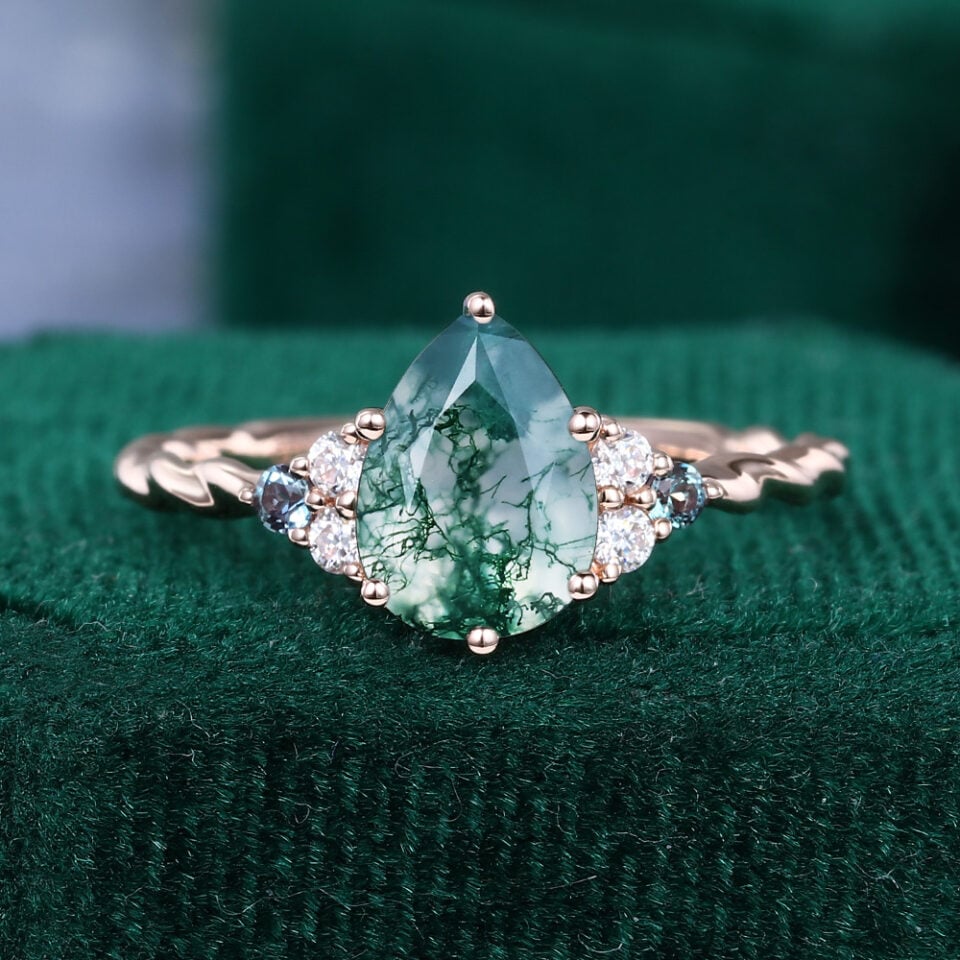
Ring-quality moss agate must look good without ideal lighting.
We test stones against skin and metal, not just white backgrounds. A high-quality stone should retain clarity and depth under normal indoor and outdoor lighting conditions.
Many lower-grade moss agates are better suited to pendants, where light can pass through more freely. Rings demand stronger visual performance from every angle.
7. Price Signals: When Higher Quality Is Worth It
7. Price Signals: When Higher Quality Is Worth It
Price alone does not guarantee quality, but certain factors justify a premium:
- Balanced patterns that remain legible at ring scale
- Expert cutting that enhances depth and composition
- Structural integrity suitable for daily wear
- Transparent sourcing or curated selection from a specialist jeweler
Be cautious of marketing language unsupported by real, scale-accurate photos. Always look for images showing the stone as it appears on the hand.
How to Buy a High-Quality Moss Agate Ring
How to Buy a High-Quality Moss Agate Ring
When you are ready to purchase, keep the following in mind:
- Choose specialized sellers who understand alternative gemstones and provide multiple viewing angles.
- Avoid extremely cheap stones, which often have poor cuts, thicknesses, or clarity.
- Select protective settings, such as bezels, halos, or low-profile designs.
- Pair with durable metals, such as 14k or 18k gold or platinum, to extend the ring’s lifespan.
For more guidance, see our full Moss Agate Ring Buying Guide.
Conclusion
Conclusion
Identifying high-quality moss agate requires striking a balance between clear quartz and organic inclusions and between visual beauty and physical durability.
By focusing on transparency, contrast, thoughtful cutting, and structural integrity, you can choose a stone that feels more like a miniature work of natural art than a green rock.
At MollyJewelryUS, we hand-select ring-grade moss agate and optimize each cut to showcase its best features. We also recommend settings that protect the stone while highlighting its beauty.
FAQ: High-Quality Moss Agate
FAQ: High-Quality Moss Agate
Is Moss Agate Good for Engagement Rings?
Yes. With a Mohs hardness rating of 6.5-7, high-quality moss agate can withstand daily wear when cut and set properly in a protective mounting.
What Makes Moss Agate High Quality?
It has readable dendritic patterns, suitable transparency, expert cutting, and sufficient thickness.
Why Do Some Moss Agate Rings Look Cloudy?
Cloudiness usually comes from a milky chalcedony base. These stones often lose detail at small sizes and are better suited to pendants than rings.
Does a Higher Price Always Mean Better Moss Agate?
No, skilled cutting and thoughtful selection matter more than price alone. A well-chosen, moderately priced stone can outperform a poorly cut, overpriced one.