Last updated on August 18, 2026
Blue Topaz and Aquamarine can look surprisingly similar, but they are different gemstones with different colors, treatments, prices, and levels of rarity.
Blue Topaz is usually the more affordable choice for a vivid blue look, while Aquamarine is valued for its softer blue color and greater natural rarity.
If the question is which one is “better,” there is no universal answer. The better choice depends on the look, budget, and type of jewelry you have in mind.
Table of Contents
- Blue Topaz vs Aquamarine: Quick Comparison
- What Is the Difference Between Blue Topaz and Aquamarine?
- How Can You Tell Blue Topaz From Aquamarine?
- Blue Topaz or Aquamarine: Which Should You Choose?
- How to Care for Blue Topaz and Aquamarine
- Frequently Asked Questions
- Final Thoughts
Blue Topaz vs Aquamarine: Quick Comparison
| Blue Topaz | Aquamarine | |
|---|---|---|
| Color | Bright to deep blue | Soft blue to blue-green |
| Price | Usually more affordable | Usually more expensive |
| Hardness | 8 | 7.5–8 |
| Treatment | Most vivid blue is treated | May be heat-treated |
| Rarity | Widely available | Rarer, especially fine color |
The easiest way to remember the difference: Blue Topaz is usually about vivid color and affordability; Aquamarine is about softer color and rarity.
Blue Topaz vs. Aquamarine: What’s The Difference?
1. Appearance: Color Comparison
Color and appearance should be the primary reason you’re looking at these two gemstones, right?
Here’s a little “warm-up” before we dive in: look at the pictures below. Can you tell which is blue topaz and which is aquamarine?

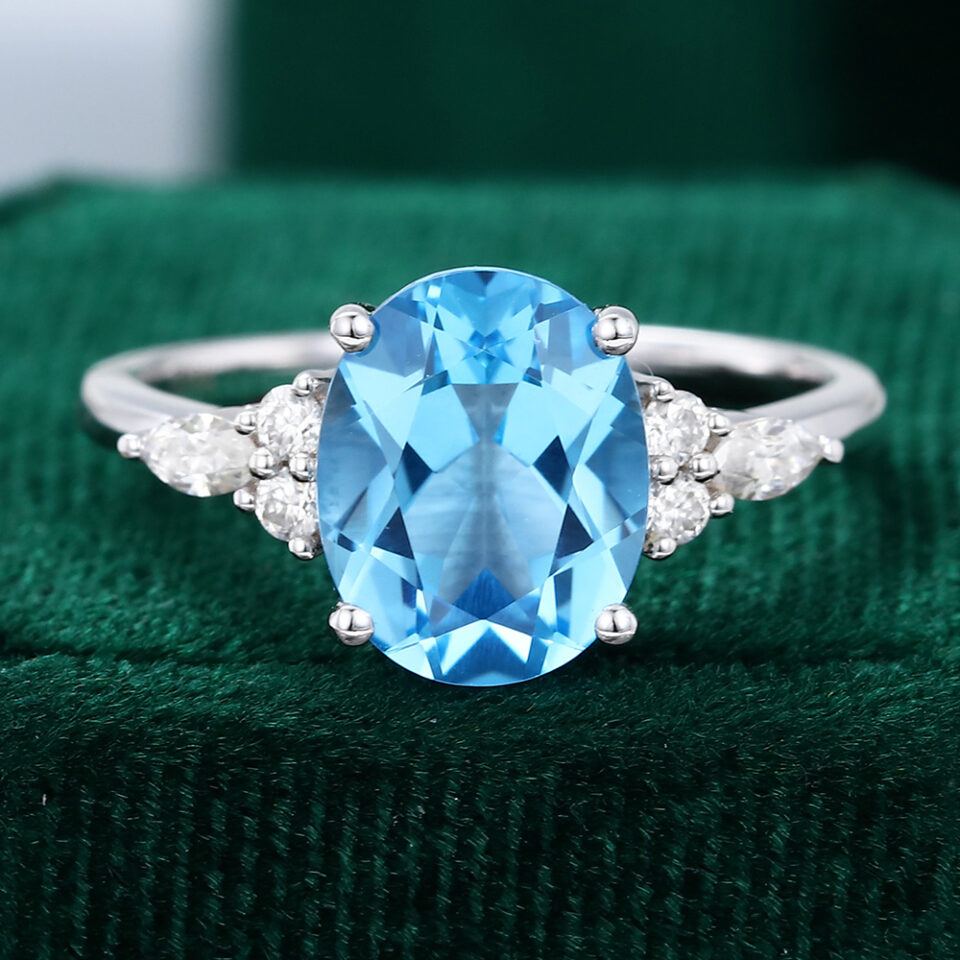

If your answer is “left one is aquamarine, the other two are blue topaz”, congratulations, you’re correct. (Click images to view related products.)
As the pictures show:
Blue Topaz is striking, bold blue, ranging from light sky blue to deep blue. Common colors are “Sky Blue”, “Swiss Blue”, and “London Blue”. (Natural blue topaz is an extremely light ice blue (very rare); while the bright vivid blues we commonly see are irradiated and heat-treated).

Aquamarine? As the name suggests, it has a dreamy, soft, ocean-like blue, sometimes leaning towards bluish-green, with a lower saturation.

Simply put:
If you’re after a bold and vibrant look, Blue Topaz will meet your needs.
Want that soft and elegant vibe? Aquamarine is the choice for you.
2. Durability: Which Gemstone is More Durable?
This is a very practical question, as durability is important for everyday wear.
Blue Topaz has a Mohs hardness of 8.
Aquamarine follows closely behind, with a Mohs hardness between 7.5 and 8.
This means that both gemstones are durable enough for everyday use.
It’s worth noting, however – if subjected to a strong impact, Topaz is more prone to cracking and breaking due to the cleavage of its crystal structure. (Topaz cleavage: [001] Perfect; Aquamarine cleavage: Imperfect on {0001}).
3. Price Comparison: Blue Topaz vs Aquamarine
How can we not compare their prices? This is one of the necessary considerations when shopping.
Blue Topaz is an affordable gemstone, with the price of 1-carat Blue Topaz typically not exceeding $100 (loose stone). This is mainly due to its availability and ease of processing (yes, most are irradiated and heat-treated to achieve the perfect blue color).
If you’re on a budget, you can get a larger Blue Topaz without spending too much.
Aquamarine? More expensive. The price of 1-carat Aquamarine (loose stone) ranges from several hundred dollars to a few thousand dollars.
It’s rarer, and its natural blue hues make it a luxurious gemstone, and usually the darker the blue the higher the price.
In short: Blue Topaz is great for budget-conscious buyers, while Aquamarine is for those looking to invest.
4. Symbolism: The Energy of Blue Topaz and Aquamarine
Not everyone is interested in the meanings of gemstones, but if you are, here’s the rundown:
Blue Topaz is usually associated with clarity, communication, and wisdom.
It’s a popular choice for those who want to bring a sense of calm and mental clarity to their lives.
Aquamarine, on the other hand, symbolizes tranquility, peace, and courage.
It is associated with the water element and is often used to soothe emotions. (Sailors and travelers wear it to seek protection and peace.)
Simply put:
Need clarity of thought? Blue Topaz.
Looking for peace and courage? Aquamarine.
5. Blue Topaz vs. Aquamarine: Treatment and Enhancement
When choosing gemstones, it’s important to understand their treatments and enhancements. The color and appearance of gemstones often vary depending on these treatments.
The vast majority of Blue Topaz on the market is created by irradiating and heat treating colorless or light-colored topaz to achieve the desired blue hues. (Natural blue topaz is very pale and extremely rare.)
The vast majority of aquamarine is natural, which is one of the reasons for its higher price. However, some people also heat treat Aquamarine to remove the greenish tint and enhance its pure blue color.
These treatments are safe and do not affect the gemstone’s durability, stability, or value.
How Can You Tell Blue Topaz From Aquamarine?
Color can provide a clue, but appearance alone is not a reliable way to confirm gemstone identity.
A vivid, highly saturated blue is commonly associated with treated Blue Topaz. Aquamarine usually has a softer blue or blue-green appearance.
But there can be overlap.
If gemstone identity matters when purchasing jewelry, check the product description, treatment disclosure, seller information, or an independent gemological report rather than relying on color alone.
This is particularly important because both gemstones can be very clean. GIA notes that most cut Aquamarine is eye-clean, while fashioned Topaz is also often free of visible inclusions.
Blue Topaz or Aquamarine: Which Should You Choose?
The decision becomes much easier when the priorities are clear.
Blue Topaz
Blue Topaz is a strong choice when the priority is:
- A vivid blue color
- A larger gemstone for the budget
- A more affordable price
- A bold, noticeable look
Aquamarine
Aquamarine may be more appealing when the priority is:
- A softer blue color
- Natural gemstone character
- Greater rarity
- A more understated look
For an engagement ring or other frequently worn jewelry, also consider the setting. Both stones are durable enough for jewelry, but Topaz’s cleavage means it deserves particular protection from hard impacts.
Blue Topaz offers strong color and affordability. Aquamarine offers softer color and greater rarity.
How to Care for Blue Topaz and Aquamarine
Warm soapy water and a soft cloth are the safest simple cleaning method for both gemstones.
For Blue Topaz, avoid hard impacts and sudden temperature changes. Its cleavage makes it more vulnerable to breakage than its Mohs hardness might suggest.
For Aquamarine, avoid excessive heat and protect the stone from hard knocks. Warm soapy water is a safe cleaning method.
For both:
- Remove the jewelry during heavy physical activity.
- Keep gemstones away from harsh chemicals.
- Store pieces separately to reduce scratches.
- Check the setting periodically.
There is no need to follow a rigid “every one or two months” cleaning schedule. Clean the jewelry when it needs it, and have the setting checked when necessary.
Frequently Asked Questions
Generally, yes. Fine Aquamarine is rarer, while vivid Blue Topaz is widely available because its blue color is commonly produced through treatment.
Blue Topaz is a real Topaz gemstone, but most vivid blue Topaz is treated. Irradiation and heat treatment are commonly used to produce its blue color.
Blue Topaz has a Mohs hardness of 8, while Aquamarine is 7.5–8. However, Topaz has perfect cleavage, so it can be more vulnerable to splitting from a strong impact.
Not reliably. Color can suggest a difference, but it cannot confirm gemstone identity.
Yes. Their different blue tones can create an attractive contrast in mixed-gemstone jewelry. Blue Topaz tends to provide stronger color, while Aquamarine creates a softer blue accent
Blue Topaz is appealing for vivid color and affordability, while Aquamarine is a stronger choice for shoppers who value its softer blue and greater rarity. The setting should also protect the gemstone from hard impact.
Final Thoughts: Blue Topaz or Aquamarine?
Blue Topaz and Aquamarine may look similar, but they offer very different buying experiences.
Blue Topaz is generally more affordable, more widely available, and available in stronger blue shades through treatment. Aquamarine is generally rarer, more expensive, and known for its softer blue to blue-green color.
The choice is ultimately about what matters most:
Bold color and affordability → Blue Topaz
Soft blue color and rarity → Aquamarine
Explore MollyJewelryUS’s Blue Topaz Rings and Aquamarine Rings to see how these two gemstones translate into finished jewelry designs.